A Week of Porting With and Without LYNCIS GAMES: Where the Months Go
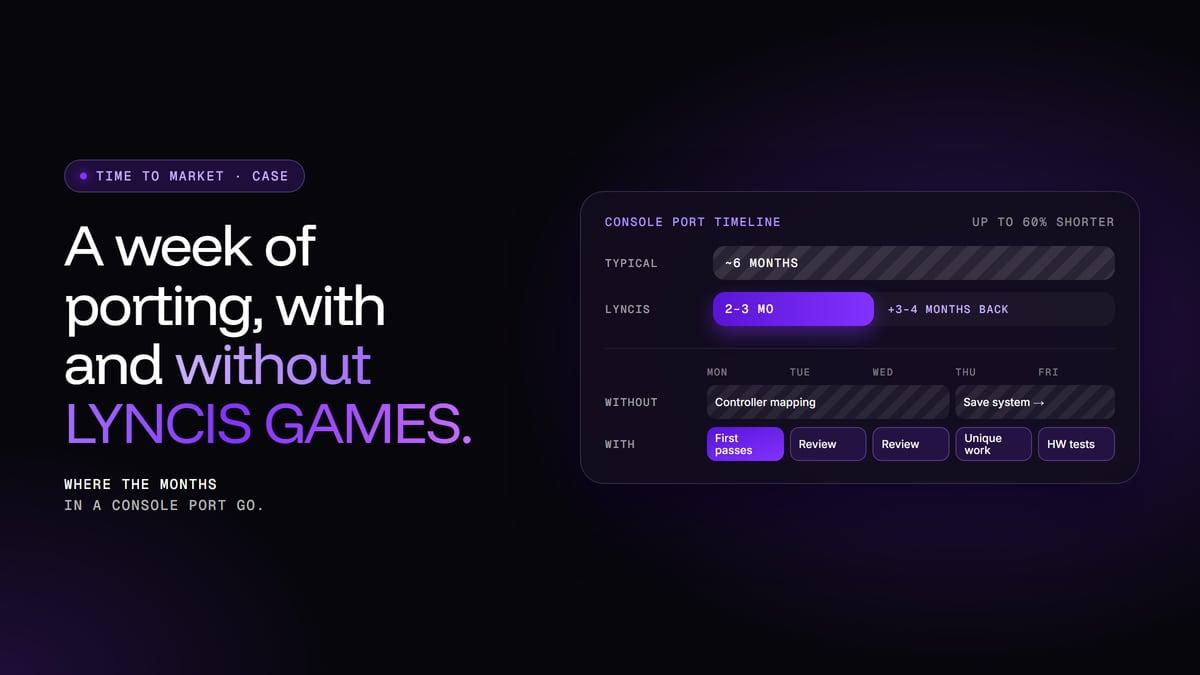
A typical console port takes around six months, and around 70% of that time is recurring engineering work. One week of the port, side by side with and without our framework, shows where the time goes and how three to four months come back.
 Krystian MlodziejewskiBusiness & Relations Director
Where do the months in a console port go?
A typical port takes around six months. Not because teams are slow, but because most of that time goes into work every port needs: understanding the codebase, adapting platform systems, integrating SDKs, controllers, saves and achievements. Problems the industry has solved many times, just never on this particular game.
The easiest way to see it is to zoom in on a single week.
The numbers behind the six months
- A typical port: around six months.
- Recurring engineering work: around 70% of that time, by our estimate.
- With LYNCIS GAMES: up to 60% shorter, roughly two to three months.
- Time back for the studio: about three to four months.
The 70% does not mean the port does itself. It means most hours go into problems with known solutions, rediscovered on every project.
One week in the port, side by side
Here is one week from the middle of a port, when the team adapts the game to console. It is an illustrative week, built from the task times we publish on the LYNCIS GAMES page, not a timesheet from one project. Every game is different, but the pattern repeats.
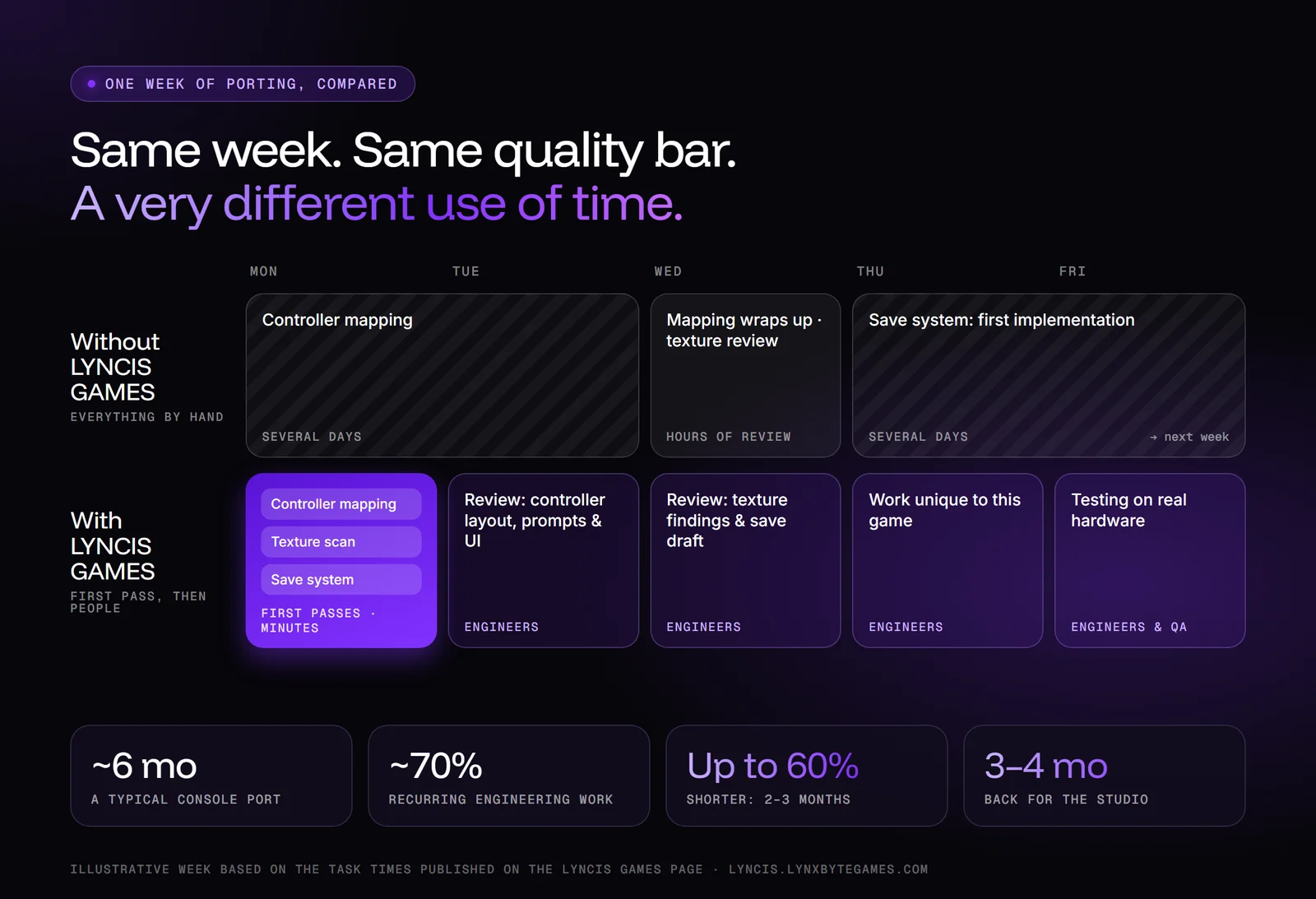
| Day | Without LYNCIS GAMES | With LYNCIS GAMES |
|---|---|---|
| Monday | Controller mapping: keyboard input to a controller layout, by hand | First passes for controller mapping, the texture scan and the save system, in minutes each |
| Tuesday | Controller mapping, day two | Engineers review the controller layout, button prompts and UI |
| Wednesday | Controller mapping wraps up; hours of manual texture review | Engineers review the texture findings and the save system draft |
| Thursday | Save system: first implementation begins | Work that is unique to this game |
| Friday | Save system, day two, with more to come next week | Testing on real hardware |
Three tasks, the same quality bar, a very different week:
| Task | Manual work | LYNCIS GAMES first pass |
|---|---|---|
| Controller mapping | Several days | Minutes |
| Texture scan | Hours of review | Minutes |
| Save system, first implementation | Several days | Minutes |
A first pass is a draft, not a finished feature. Engineers still review and finish it. But they start the week with a draft in hand instead of a blank file, and they spend their time on decisions rather than on typing out the same platform plumbing again. Sylwester drew exactly where that line runs.
Week by week, the months come back
One week like this does not change a release date. Twenty of them do.
The port-and-verify phase of a LYNCIS GAMES port takes 8 to 20 weeks. When most of the recurring tasks in those weeks start from a first pass instead of from zero, the whole timeline shortens: up to 60%, from around six months to roughly two to three.
That is the time that comes back to the studio, and three to four months is a lot in this industry:
- A console release that lands while the PC launch is still fresh.
- A sale or a festival you can still make.
- A team that moves on to its next project a season earlier.
Faster does not mean fewer checks
Studios rightly ask where the time comes from, so to be clear: not from skipping steps.
- Every production change is reviewed by a human developer before it enters the build.
- Testing on real hardware stays part of the process.
- Our in-house QA team tests the final build before release.
The time comes out of the repetitive work, not out of the quality.
A real project through the same lens
Przemek looked at The Cub through the same lens: a Unity platformer ported to Xbox Series X|S and Xbox One as one build, tested on real hardware across three consoles, which passed certification on the first attempt. Read where the time went on The Cub.
How the time shows up in the price
The shorter timeline is built into our fixed-price tiers: target delivery is up to 3 months for Indie (€35K), around 4 months for Premium Indie (€45K) and around 5 months for AA (€60K), for PlayStation 5, Xbox Series X|S, WinGDK and Nintendo Switch 1 and 2 together. Sylwester breaks down the costs in How Much Does It Cost to Port a Game to Console.
Planning a console release and want to know what your timeline could look like? Go through the quote checklist and get a fixed-price estimate.
Frequently Asked Questions
Why does a console port take around six months?
Because most of the time goes into recurring engineering work: understanding the codebase, adapting platform systems and integrating SDKs, controllers, saves and achievements. We estimate that around 70% of a typical port is this kind of work.
How much faster is a port with LYNCIS GAMES?
Up to 60% shorter: roughly two to three months instead of around six, which gives the studio about three to four months back.
What changes in a week of porting with LYNCIS GAMES?
First passes on recurring tasks take minutes instead of days. For example, controller mapping and a first save system implementation take several days by hand, and a texture scan takes hours of review. Engineers then review the drafts and spend the rest of the week on work unique to the game and on testing.
Does a faster port mean less testing?
No. Every production change is reviewed by a human developer, testing on real hardware stays part of the process, and our in-house QA team tests the final build before release.
Is the week in this article from a real project?
It is an illustrative week built from the task times we publish for manual work and for the LYNCIS GAMES first pass. Every project is different; the technical review gives you the timeline for your game.