Fixed Price vs Time and Materials: Which Model Fits Your Game Port?
Hourly billing and a fixed price split the risk of a port in very different ways. A side-by-side comparison of time and materials and fixed-price game porting, and how to tell which one your project needs.
 Przemysław ChmuraBusiness Development Representative
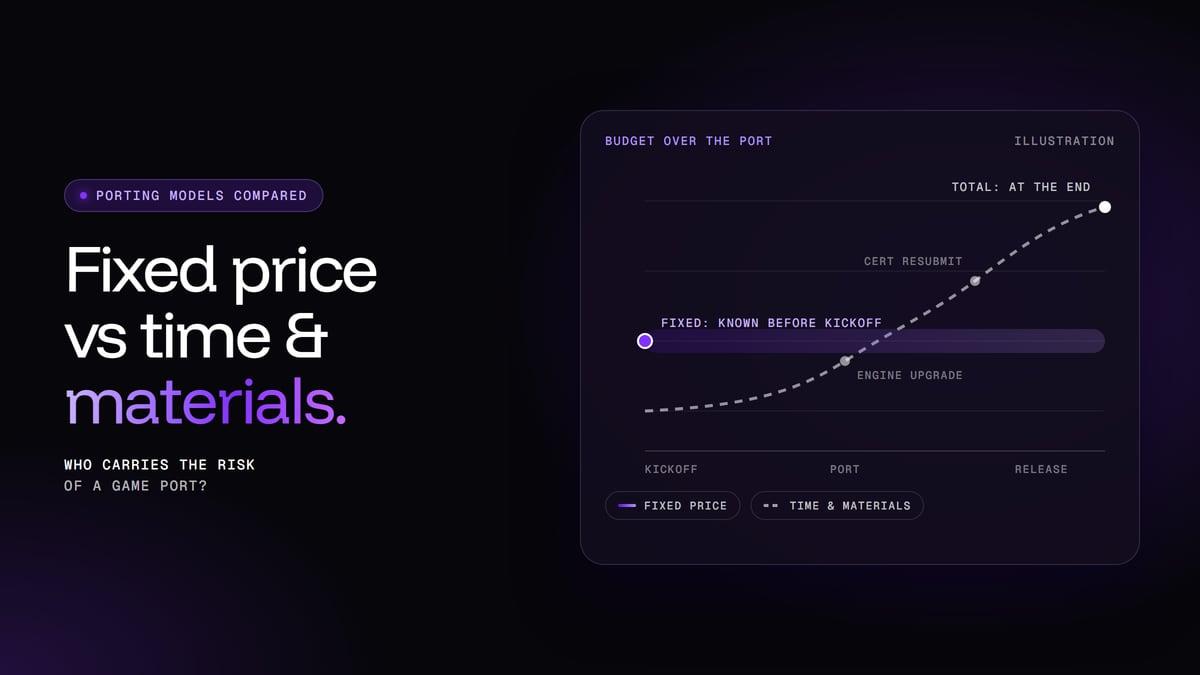
When a studio compares porting offers, the numbers on the page are rarely comparable. One offer is a rate per hour or per month. Another is a single price. They look like two prices, but they are two different ways of sharing risk.
Here is how I explain the difference to publishers and studios.
The two models in one sentence each
- Time and materials: you pay for the time the team spends, whatever the project turns out to need.
- Fixed price: you pay an agreed amount for an agreed scope, whatever the work turns out to take.
Side by side
| Time and materials | Fixed price | |
|---|---|---|
| What you pay for | Hours or days worked | An agreed scope |
| When you know the total | At the end of the project | Before the port starts |
| Who carries the risk of surprises | You | The porting partner, within the scope |
| What happens when work takes longer | The bill grows | The price stays the same |
| How scope changes are handled | Absorbed into the hours | Quoted separately, before the work |
| What it needs up front | A rough brief | A technical review of the project |
| Budget planning | A range, revised as you go | One number |
Where hourly billing goes wrong in a port
Porting is full of unknowns until someone opens the project. An engine upgrade nobody planned for. A controller and UI rework that turns out bigger than expected. A certification failure that sends the build back for another round.
None of that is unusual. With hourly billing, every one of those surprises lands on your invoice, and the estimate you planned around stops meaning much somewhere in the middle of the project.
When time and materials makes sense
A fixed price is not the right tool for everything, and we don't pretend it is. Hourly or custom arrangements fit better when the scope cannot be pinned down yet, for example:
- the game is still in active development and its scope keeps moving,
- the work is closer to development than porting, such as new features or a new online architecture,
- the project needs open-ended research before anyone can say what the port involves.
That is also why LYNCIS GAMES has Tier 5 / Custom for remakes, remasters, mobile ports and custom engines: those projects get a delivery plan tailored to them instead of a Factory price.
When a fixed price makes sense
A fixed price works when the scope can be defined, and for most ports it can:
- the game is released or feature-complete, ideally with a frozen PC baseline,
- the engine is a known quantity, such as Unity or Unreal Engine,
- the goal is clear: the same game, working and certified on new platforms.
If PC work will continue during the port, that is fine too. We include it in the classification from the start.
What makes a fixed price possible
A fixed price is only honest if it rests on real knowledge of the project. That is why every LYNCIS GAMES port starts with a technical review of 3 to 7 days: the repository, the build pipeline, controller readiness and performance. It is a form of technical due diligence, done before the contract rather than halfway through the port.
The review places the game in a tier and confirms the scope, the delivery time and the price:
| Tier | Fixed price | Target delivery |
|---|---|---|
| Tier 1 / Indie | €35K | Up to 3 months |
| Tier 2 / Premium Indie | €45K | Around 4 months |
| Tier 3 / AA | €60K | Around 5 months |
Sylwester breaks down what each tier covers in How Much Does It Cost to Port a Game to Console.
How changes work with a fixed price
A fixed price does not mean nothing can change. It means changes are visible and priced before they happen. The price moves only when the agreed scope does, for example:
- new platforms added after the scope is agreed,
- DLC, new game modes, features or content,
- engine changes or major backend changes,
- substantial changes to the PC version after the baseline is agreed.
Each of those gets its own quote. Publishers with several games can go one step further with the Portfolio model, where predefined changes have fixed prices agreed up front.
Which one is right for your port?
Ask one question: can the scope be defined today? If the game is finished or close to it and you want it on more platforms, a fixed price gives you a number you can plan around. If the scope is still moving, start with a custom conversation.
Not sure where your game sits? Send us a message or fill in the estimate form, and we will tell you which model fits.
Frequently Asked Questions
What is the difference between fixed price and time and materials?
With time and materials you pay for the hours worked, so the total is known only at the end. With a fixed price you pay an agreed amount for an agreed scope, known before the work starts.
Who carries the risk in a fixed-price port?
The porting partner carries the risk of the work taking longer than planned, within the agreed scope. Changes to the scope itself are quoted separately.
Is a fixed price more expensive than hourly billing?
A fixed price puts the risk of surprises on the porting partner, which is why it rests on a technical review first. The difference is predictability: you know the total before the port starts instead of at the end.
When is time and materials a better choice?
When the scope cannot be defined yet, for example when the game is still in active development, the work includes new features or a new online architecture, or the project needs open-ended research first.
How does LYNCIS GAMES set a fixed price?
Through a 3 to 7 day technical review of the repository, build pipeline, controller readiness and performance. The review places the game in a tier: €35K for Indie, €45K for Premium Indie or €60K for AA.