Got 5 Games in Your Catalogue? The Portfolio Model, Step by Step - One Deal, One Schedule
Porting a catalogue title by title means a new quote, a new negotiation and a new wait for every game. Here is how the LYNCIS GAMES Portfolio model (Tier 4) works for studios and publishers planning more than three ports.
 Przemysław ChmuraBusiness Development Representative
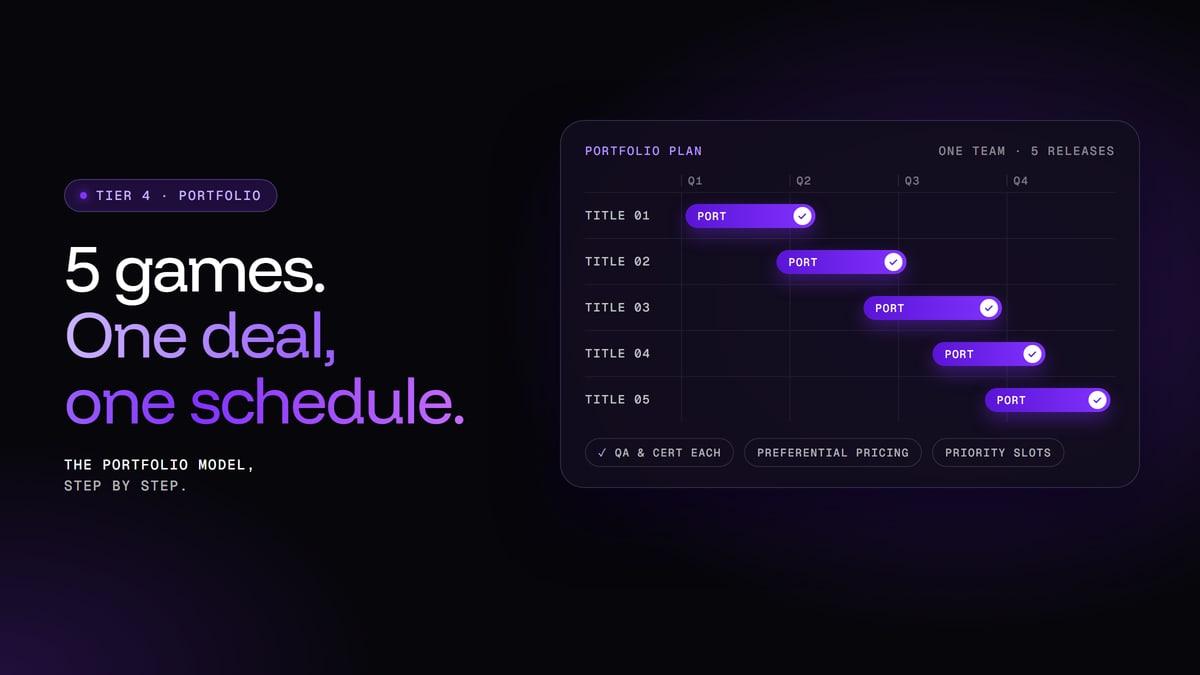
Got five games in your catalogue? You don't need five separate porting deals.
I talk to a lot of publishers, and the pattern is always the same. A catalogue gets ported title by title, and every title starts from zero: a new quote, a new negotiation, a new wait for a free slot. Then every small change during the port gets renegotiated on top.
That is why we built the Portfolio model.
Title by title: where the time and money go
Porting one game at a time works for one game. For a catalogue, it multiplies the overhead:
- A new quote for every title, each starting from a blank page.
- A new negotiation every time, with legal and commercial back-and-forth repeated per game.
- A new wait for a free slot, so the release plan depends on whoever happens to be available.
- Every small change renegotiated while the port is running.
None of that makes the games better. It just makes the catalogue slower and harder to plan.
What the Portfolio model gives you
The Portfolio model is our Tier 4, built for studios and publishers planning to port more than three games:
- ✅ One commercial and production model for the whole portfolio, instead of a separate deal per title.
- ✅ Preferential pricing across the group of games.
- ✅ Priority availability in our schedule.
- ✅ Fixed prices for predefined changes and additional work, agreed up front, so there is no renegotiating every small change.
On top of that, QA and certification are part of every release, as in every LYNCIS GAMES port.
How it works, step by step
1. List the games and platforms
Send us the titles you want to port and the platforms you are aiming for. A rough list is enough to start.
2. A technical review places each title
Each game goes through a technical review of its repository, build pipeline, controller readiness and performance. That places every title in its tier and scope, using the same factors as a single port: engine and build, project scale, online and saves, and the game profile. You can check where a game lands in four questions.
3. We agree one model for the whole portfolio
Instead of a contract per game, we agree one commercial and production model for the catalogue, with the pricing, the schedule and the fixed price list for predefined changes in one place.
4. One team ports the games, one after another
One team works through the portfolio in sequence. Every release gets its own QA and certification, so each game ships on its own terms.
Who it is for
- Publishers with a back catalogue that should reach new platforms.
- Studios with several released games they want on console.
- Anyone planning more than three ports, whether they start this year or next.
If you only have one or two games, the standard tiers fit better: Indie at €35K, Premium Indie at €45K and AA at €60K. The fixed-price porting guide explains them in detail.
Plan the catalogue, not just the next port
A catalogue is worth more when it is planned as a whole. Planning ports for several titles in 2027? Send us a message or get a free estimate, and we will start with the list.
Frequently Asked Questions
What is the LYNCIS GAMES Portfolio model?
It is Tier 4 of LYNCIS GAMES pricing: one commercial and production model for studios and publishers porting more than three games, with preferential pricing, priority availability and fixed prices for predefined changes and additional work.
How many games do I need for the Portfolio model?
It is built for studios and publishers planning to port more than three games. One to three games use the standard Indie, Premium Indie and AA tiers.
How is each game priced in a portfolio?
A technical review places each title in its tier and scope. The pricing for the whole group is then agreed in one model, with preferential pricing across the games.
What happens if the scope of a game changes?
Predefined changes and additional work have fixed prices agreed up front, so small changes don't need to be renegotiated during the port.
Do QA and certification apply to every game?
Yes. Every release in the portfolio gets its own QA and certification.